Home
Geothermal Rising :: Using the Earth to Save the Earth
Using the Earth to Save the Earth

Main navigation

  • Our Organization
    • Membership
    • Mission and Vision
    • Our Members
    • Board of Directors
    • Staff
    • Committees
    • U.S. Policy Council
    • Canada Policy Council
    • Student Committee
    • Contact Us
    • In Memoriam: Remembering Our Geothermal Pioneers
  • Our Impact
    • The 2026 New Tech Awards
    • Regional Interest Groups (RIGs)
    • In the News
    • Workforce Success
    • GR Museum Exhibit
    • Honors & Awards
    • Bulletin Blog
  • Events
    • 2026 Thermal Energy Networks Symposium
    • 2026 Geothermal Rising Technical Symposium: Mutual Challenges & Solutions
    • 2026 Geothermal Investment Forum
    • 2026 Geothermal Capitol Hill Day
    • 2026 Indigenous Geothermal Symposium (Calgary)
    • 2026 Geothermal Rising Conference
    • GRC Conference 2025
  • Resources
    • Find Our Resources
    • Library
    • Geothermal Basics
    • Frequently Asked Questions
    • Geothermal Power Production
    • Direct Use Geothermal
    • Geothermal Ground Source Heat Pumps
    • Geothermal Directory
    • Student Resources
    • Job Board
    • Video Library
    • Merchandise
  • Invest in Our Impact
    • Join Us
    • Donate
    • Give the Gift of Light
    • Receive the newsletter
    • Sponsorship & Advertising
  • Member Login
    • Exhibits & Sponsors
      • Exhibit & Sponsor Information
      • 2025 Exhibitors & Sponsors
    • About
      • About
    • Program
      • Agenda
      • Detailed Agenda
      • Field Trips
      • Geothermal Discovery Day
      • Golf Tournament
      • Panel Sessions
      • Student Activities
      • Workshops
    • Registration
    • Technical Program
      • Author Information
      • Author Resources
      • Technical Paper Authors
      • Technical Poster Authors
      • Technical Program Topics
    • Hotel & Travel

Keeping Tools Cool to Reach Hotter Geothermal Wells

Submitted by bschmidt on Mar 19, 2026
  • Read more about Keeping Tools Cool to Reach Hotter Geothermal Wells
Date
Mar 18, 2026
Geothermal Community
Geothermal Rising
Image
NOV blog graphic
When Temperature Becomes the Real Drilling Limit

Most BHA components in high-temperature wells are designed for a maximum operating temperature around 149°C (300°F). In contrast, formation temperatures in some shale and geothermal wells already exceed 177°C (350°F). As the circulation loop runs, the relatively cool mud that is pumped down the drillpipe absorbs heat from the hot rock around the wellbore. At the bit, the mud turns and returns toward the surface in the annulus as hotter circulating mud. Because the well is drilled overbalanced, native formation fluids stay in the rock, and it is the drilling mud that picks up and carries the heat. By the time mud reaches the bottom hole assembly, its temperature is much closer to the formation temperature, which is the temperature the tools actually have to withstand.

Elevated temperatures do more than stress electronics. They accelerate corrosion, erosion, and fatigue in steels and elastomers and degrade mud rheology, thinning the fluid and reducing its ability to clean the hole. The result is familiar to drilling engineers: more unplanned trips, more tool failures, and more non-productive time.

Whether the well is chasing gas in the Eagle Ford or heat in a geothermal project, the central question is the same. How do we keep the circulating system cool enough for the tools to survive, without sacrificing performance?

Quote
Temperature becomes the silent failure driver long before the rock wins. If we can manage the heat, the rest of the drilling system can do its job.
Attribution
Michael Adams, Director of Corrosion Control Technical Support at NOV Tuboscope
Turning Drillpipe into a Thermal Shield

NOV’s Tuboscope business unit has spent decades developing internal coatings that extend tubular life by resisting corrosion, wear, and deposit buildup while maintaining hydraulic efficiency. As operators in oil and gas and geothermal began seeking a coating that could also serve as a thermal barrier, the research team focused on one key property: thermal conductivity.

Image
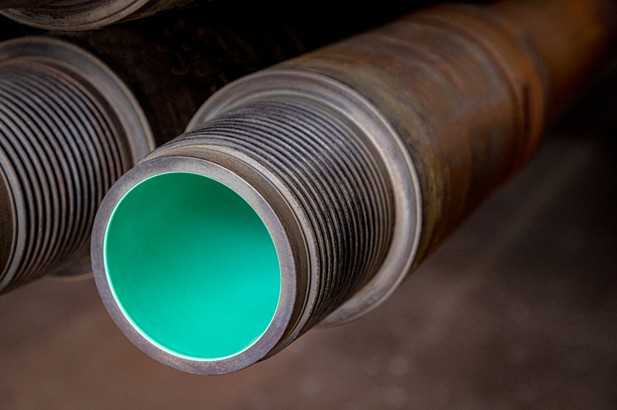
TK Drakōn coated drillpipe
Caption
Close interior view of TK Drakōn coated drillpipe, showing a glossy green inner surface, a threaded connection in the foreground, and the pipe body receding into the background to suggest depth.

Carbon steel drillpipe has a thermal conductivity of roughly 45 W/m·K, so it readily conducts heat from hot rock and annular fluids into the cooler mud inside the pipe. Legacy internal coatings improved corrosion resistance but did relatively little to slow heat flow.

Using a heat flow meter, NOV tested candidate coatings across a wide temperature range. 

Earlier coatings averaged about 0.84 W/m²K. Through multiple iterations, the team developed TK Drakōn with an average thermal conductivity of 0.162 watts per meter Kelvin, more than five times lower than that of previous coatings and nearly 280 times lower than that of steel. The inside of the pipe becomes a significantly cooler pathway for drilling fluid.

TK Drakōn was also subjected to high temperature, high-pressure exposure, immersion in corrosive solutions, and physical tests for abrasion, impact, and flexibility. The coating is applied in a thin 20 to 30 mil (0.5 to 0.75 millimeter) layer that preserves a smooth internal surface, supports efficient flow, and limits the buildup of scale and solids.

With more than 1.0 million feet (about 305,000 meters) of TK Drakōn-coated pipe in service, the coating has moved from concept to a standard option for high-temperature drilling. For geothermal developers, it offers a qualified way to manage heat along the drillstring while also protecting tubulars from aggressive brines.

Two-Stage Mud Chilling in the Field

Managing temperature inside the well starts at the surface. Once hot mud returns from the hole, it passes through shakers and solids-control equipment, then becomes a candidate for cooling before being pumped back downhole. 

Conventional mud cooling often relies on evaporative or air-based systems that struggle in hot, humid environments and may require large volumes of water. Chillers use a closed refrigeration loop to remove heat from the fluid and can maintain precise temperature control without external water.

NOV’s Tundra Max mud chiller combines air cooling and chiller technologies in a two-stage, closed-loop package. In the first stage, an air cooling unit removes heat from the drilling fluid by transferring it into a circulating water loop. In the second stage, a refrigeration unit removes additional heat from the same water loop, allowing it to continue pulling heat from the mud. Both stages use plate and frame heat exchangers in a counter-flow configuration, where the drilling fluid flows in one direction, and the cooling water flows in the other, which increases contact and improves heat transfer from the hot drilling fluid to the cooling medium.

The trailer-mounted unit can handle oil-based, synthetic-based, and water-based muds. In the first stage, an air-cooling unit removes heat from the water loop. In the second stage, a refrigeration unit chills that loop further. Both stages use plate-and-frame heat exchangers in a counterflow configuration to transfer heat between the mud and the cooling medium.

At the rig site, Tundra Max draws relatively clean fluid from the suction tank, chills it, and returns it to the solids control tank, typically the hottest point in the surface system. The result is a continuous heat sink that pulls the overall system temperature downward before the mud is pumped back into the well.

In long, high-temperature laterals in South Texas, this integrated approach delivered measurable gains. In one case study, Tundra Max lowered the active mud temperature at the surface by an average of 29.5°C, from 61.7°C at the inlet to 32.2°C at the outlet. With the mud chiller alone, the bottom hole temperatures were reduced to about 186°C, even though the undisturbed formation temperature was close to 196°C. When the chiller was combined with TK Drakōn-coated drillpipe, the bottom-hole circulating temperatures in the wellbore dropped further to an average of 159°C. That additional margin improved the operating environment for downhole electronics and elastomers and reduced heat-related risks for personnel at the surface.

Image
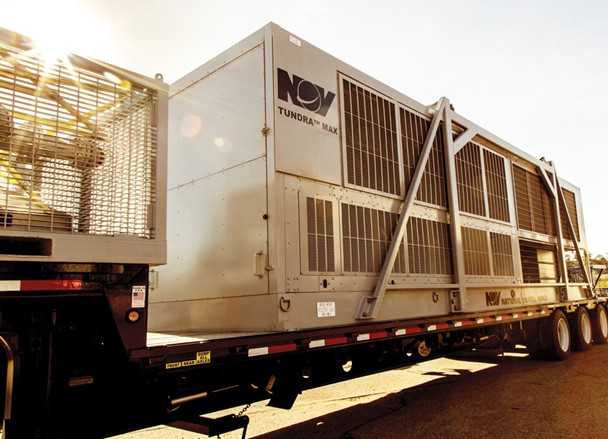
Wide shot of the Tundra Max skid and trailer beside a drilling rig, with visible hoses connected to the mud system, fans or heat exchangers clearly in view, and workers in standard PPE to convey scale and real-world deployment.
Caption
Wide shot of the Tundra Max skid and trailer beside a drilling rig, with visible hoses connected to the mud system, fans or heat exchangers clearly in view, and workers in standard PPE to convey scale and real-world deployment.
From HPHT Lessons to Superhot Geothermal

As lateral lengths approach 8 kilometers and geothermal concepts push toward supercritical and superhot conditions, drilling will increasingly be limited by the tools that can tolerate them, not just by rock mechanics. Temperature in the circulation system is something operators can actively design around.

For geothermal projects, whether conventional hydrothermal, enhanced geothermal systems, closed-loop designs, or superhot pilots, the path is similar. Assume active temperature management from the earliest phases of well design. Pair downhole insulation, such as TK Drakōn, with surface cooling, such as Tundra Max, as standard practice in high temperature campaigns. Use early wells in a field to tune bit selection, trajectory, hydraulics, and the thermal profile of the circulation system.

NOV is already extending its coating and cooling expertise into geothermal projects. These cross-sector lessons are relevant to a community experimenting with new well architectures and resource types while still relying on many of the same drilling fundamentals.

Takeaway for the Geothermal Community

The story behind TK Drakōn and Tundra Max is less about individual products and more about a systems approach to heat. By reducing heat transfer into the drilling fluid and removing heat at the surface, NOV’s integrated system keeps BHAs operating closer to their rated lifespans, reduces non-productive time due to temperature-driven failures, stabilizes mud properties, and improves rig safety. Across multi-well campaigns, those gains compound and drive down cost per meter drilled.

As a participant in the Geothermal Rising community, NOV brings high-temperature drilling experience and a coatings and fluids portfolio that can be adapted for geothermal. In an industry-driven organisation that exists to connect subsurface innovators, this kind of technology transfer supports a shared goal: making clean, always on geothermal energy a practical choice in more places around the world.

Quote
As a community, we have to treat temperature as something we can engineer around. If we can keep tools in their comfort zone, we can go after much hotter rock with the hardware we already have.
Attribution
Michael Adams, Director of Corrosion Control Technical Support at NOV Tuboscope
Member Focus: As geothermal developers drill deeper into hotter rock, temperature, not rock strength, becomes the limiting factor. Downhole motors, sensors, and elastomers are typically rated to about 149°C (300°F), while formations can easily exceed 177°C (350°F). NOV has developed an integrated thermal management approach that couples TK Drakōn, a low-thermal-conductivity internal drillpipe coating, with the Tundra Max two-stage mud chiller. Proven in long, high-temperature wells in South Texas, this combination keeps drilling fluids cooler, extends bottom-hole assembly (BHA) service life, and reduces non-productive time (NPT), offering a practical path to drilling farther into high-enthalpy resources.

Social Acceptance of Geothermal Systems in the United States

Submitted by bschmidt on Dec 30, 2025
  • Read more about Social Acceptance of Geothermal Systems in the United States
Date
Jan 02, 2026
Geothermal Rising
Geothermal Community
Download PDF
Image
Stock photo of a stack of books

Geothermal energy has the potential to play a major role in the United States’ clean-energy transition by providing reliable, low-carbon heating, cooling, and power. Yet despite its technical strengths, geothermal deployment remains limited across much of the country. This study shows that social acceptance—how people perceive, evaluate, and feel about geothermal technologies—is now a decisive factor shaping geothermal’s real-world viability.

Based on a national survey of more than 6,000 U.S. residents, including detailed analysis across five regions and 14 geothermal-relevant states, the study compares public acceptance of geoexchange, hydrothermal, and next-generation geothermal systems. Acceptance is measured as a combination of favorability, comfort, and general support, and analyzed alongside key social and psychological drivers.

The results reveal a consistent national pattern: geothermal enjoys moderate and broadly positive acceptance across the U.S., even though public familiarity remains relatively low. Across nearly all regions and states, perceived benefits—such as reliability, affordability, and long-term value—are the strongest and most consistent drivers of acceptance. Fairness, familiarity, social responsibility, and social norms play important secondary roles, shaping how acceptance forms in different contexts.

Importantly, perceived risk does not emerge as a dominant barrier in general attitudinal evaluations, suggesting that public concern is less about fear and more about whether geothermal is seen as beneficial, fair, and socially valuable. Acceptance of next-generation geothermal, in particular, is shaped more by perceptions of long-term community benefit and societal contribution than by technical risk.

Overall, the findings indicate that geothermal’s challenge is not public opposition, but visibility, clarity, and alignment with local priorities. When geothermal is understood and framed around tangible benefits and fairness, public support is strong—providing a solid foundation for responsible scale-up.

Download Full Report

A National Assessment of Public Perceptions and Drivers of Social Acceptance
Authors
Carlos Gorraez Meraz

Introducing Geothermal Rising Canada

Submitted by bschmidt on Jan 15, 2025
  • Read more about Introducing Geothermal Rising Canada
Date
Jan 15, 2025
Geothermal Rising
Image
Geothermal Rising Canada graphic

Today, Geothermal Rising (GR) announces the acquisition of the Canadian Geothermal Energy Association (CanGEA) as an affiliate of the GR family. Going forward, CanGEA will be known as Geothermal Rising Canada! The Boards of both organizations unanimously approved the transaction and 100% of CanGEA's members authorized the affiliation. We are all thrilled to bring both organizations under common management to advance GR's important mission to unify the geothermal industry, promote all geothermal technologies and applications, and ultimately to use the Earth to save the Earth.

Geothermal Rising Canada will carry on the pivotal work of CanGEA. "I’m most proud of how we provided opportunities to the next generation of energy workers, often in support of their goals to transition to green energy. We empowered dozens of youth and underrepresented groups via employment and mentorship at CanGEA," stated former CanGEA Managing Director and Chair Alison Thompson.
 
CanGEA has successfully influenced and changed federal and provincial laws and regulations for nearly 2 decades. CanGEA has had a mission to empower the geothermal community and promote geothermal technology, same as Geothermal Rising. We are thrilled to announce that in 2025, CanGEA is becoming Geothermal Rising Canada!

“We are grateful for the dedication and impact CanGEA has made with remarkable support from volunteers, not least of which are the organization’s Board members: Alison Thompson, Brian Toohey, and Donovan Nielsen,” said Dr. Bryant Jones, Executive Director of GR. "With GR assuming control of Geothermal Rising Canada (formerly CanGEA), we can leverage resources to better and more loudly amplify the research conducted by governments, pilot projects carried out by universities, and new developments and technologies advanced by industry."

The momentum is building for the geothermal industry in Canada. The federal and provincial governments are taking notice, the World Geothermal Congress will be held in Canada in 2026, and Canadian geothermal companies are making headlines in Canada and around the globe.
 
"Geothermal energy is gaining significant momentum worldwide, with over $47 billion invested in 2023 and supporting 140,000 jobs globally. Now, more than ever, it is crucial to unite efforts and foster collaboration across the entire geothermal value chain in both Canada and the United States to build on this momentum. I am thrilled about the tremendous opportunity to leverage the expertise, resources, and influence of Geothermal Rising to enhance and scale the impactful policy and regulatory work that CanGEA has championed for the past two decades in Canada,” said Jeanine Vany, GR Board member and Executive Vice President and co-founder of Eavor Technologies.

“Geothermal Rising has effectively enhanced the visibility of geothermal heat and power technologies across the United States. The collaboration between Geothermal Rising and CanGEA will enable this important work to extend into Canada,” stated Emily Smejkal, a Science Fellow at the Cascade Institute and Board member of Geothermal Canada. “Although Canada’s geothermal resources are well-documented scientifically, their utilization has been limited. Geothermal Rising’s expertise in promoting geothermal energy in the United States will be invaluable in developing a robust industry in Canada. The establishment of Geothermal Rising Canada marks an exciting advancement for the geothermal sector.”

Through this merger, Geothermal Rising will organize knowledge sharing opportunities in Canada, empower Indigenous voices through the Indigenous Geothermal Symposium, expand the Regional Interest Group (RIG) initiative, familiarize external audiences about geothermal energy (such as the media, investors, and policymakers), and support the work of the International Geothermal Association and Geothermal Canada to host a successful WGC 2026 in Calgary!  
 
“Geothermal energy development is a North American opportunity.  It makes a lot of sense to have one body, Geothermal Rising, as the voice to represent an industry looking to grow its footprint,” said Lisa Mueller, GR Board member-elect, and CEO of FutEra Energy, the first geothermal developer in Canada to have electrons on the grid.
 
The entire Geothermal Rising staff and Board looks forward to amplifying the exciting momentum of geothermal energy in Canada.

Membership Information

Information about the Canada Policy Council


Welcoming Our New Policy Council Chair

Submitted by bschmidt on Nov 22, 2024
  • Read more about Welcoming Our New Policy Council Chair
Date
Nov 22, 2024
Geothermal Rising
Energy Policy
Image
Geothermal Rising - Icon

We’re excited to welcome Caity Smith (of Zanskar Geothermal and Minerals) as the new Chair of the Geothermal Rising Policy Council (GRPC)! Caity’s strategic leadership and passion for geothermal energy will be invaluable as she helps guide the Council into a promising future.

Image
Headshot of Caity Smith
Caption
Caity Smith

At the same time, we want to express our gratitude to Sarah Jewett (of Fervo Energy), whose leadership over the past two years has been nothing short of extraordinary. Sarah’s contributions have left a lasting impact on the geothermal community.

During her tenure, Sarah organized impactful events like the first Fervo Energy Tech Day in 2023, which brought Federal officials together to highlight the importance of geothermal energy development. She also spearheaded the Cape Station groundbreaking event, fostering bipartisan support for geothermal and earning recognition from the Department of the Interior as a model of public-private collaboration on clean energy.

Sarah’s efforts on Capitol Hill were equally remarkable. Her testimony before the House Natural Resources Committee in October 2023 was instrumental in advancing key legislation, including the Expanding Geothermal Energy on Federal Lands Act (H.R. 6474), the Geothermal Cost-Recovery Authority Act (H.R. 7422), and the Geothermal Energy Opportunity (GEO) Act (H.R. 7370). She also rallied the geothermal community in support of the Energy Permitting Reform Act, ensuring its momentum in the Senate. Throughout her leadership, Sarah championed geothermal energy in Federal appropriations, helping secure critical support for the industry.

Image
Sarah Jewett Headshot Photo
Caption
Sarah Jewett

Now, as Caity steps into this role, we’re confident she will build on Sarah’s incredible foundation. In her role as Head of Stakeholder Engagement at Zanskar Geothermal & Minerals, Inc., Caity has worked with government leaders and legislators to shape impactful policy while advancing geothermal technologies. Her dedication to the field is evident in her work with the GRPC and the Women in Geothermal (WING) US chapter.

Caity’s vision and dedication will undoubtedly propel the GRPC forward, and we are excited for the opportunities ahead under her leadership. Please join us in celebrating Sarah Jewett’s outstanding contributions and welcoming Caity Smith as she takes the helm.

Digital Solutions for Geothermal Power to Increase Operational Productivity and Longevity: Results

Submitted by bschmidt on Mar 15, 2024
  • Read more about Digital Solutions for Geothermal Power to Increase Operational Productivity and Longevity: Results
Date
Mar 15, 2024
Artificial Intelligence
Geothermal Power Production
Geothermal Rising
Image
Stock image of binary code

The results of Geothermal Rising’s’ workshop, facilitated by BiaTech Corporation: “Explore Geothermal Power Digital Solutions to Increase Operational Productivity and Longevity,” offer great insight into the current state of geothermal power generation, operational considerations, and critical areas in which data can be applied to increase productivity and longevity of the power plant. By using tools such as AI, machine learning, and digital twins, improved operational decisions can extend geothermal plant life, reduce costs, and improve performance.

We explored factors that may reduce the life of the reservoir, plant, or infrastructure and shared ways to extend life and mapped it into a framework for engineers and data scientists alike, streamlining decision making processes.

So how was it done? And what are the critical areas for improvement? Let’s explore.

First, we conducted an exercise to understand perceptions around digital tools and what the outlook for the future is. The consistent themes unearthed through this exercise were that presently, perceptions around data and digital tools are enigmatic, but the vision for the future is optimistic. Two case studies were also presented and discussed to identify and investigate root causes of problems associated with aging plants and facilities, and to prime participants for further discussion.

Then, we broke into group exercises to understand operational decisions from daily, cyclic, and long-term strategies, what data is used to make those decisions, and the systems utilized. The groups analyzed decisions from the perspective of plant operations, engineering, and leadership. By devoting time to analyzing day-to-day challenges, engineers were able to brainstorm fresh ideas and prioritize goals in making data driven decisions.

Following the group exercise was a brainstorming session in which participants used BiaTech’s Geothermal Issue Tree Analysis to create a framework that evaluated plant performance. The results of this analysis enumerated factors affecting functioning, including operational costs, capital expenses, maintenance, regulations, and market volatility, among many others. This led to ascertaining specific areas in which digital solutions can be applied for optimal performance.

The workshop identified five areas of high importance that can leverage digital solutions:

  • Using AI digital reality to map geothermal plants for operational optimization
  • Using data to improve dashboards of plant performance, steamfields, and reservoirs
  • Using AI models for historical analysis and measurement of seismicity
  • Identifying areas of high risk, including pipeline conditions like corrosion
  • Monitoring support for operator walk and thermal trending via drone computer vision
  • Explore advanced sensor retrofit for reservoir and well monitoring
  • Assess the health of current systems and options to integrate digital solutions

The world is undergoing a digital revolution, but many companies are ill equipped to benefit from the transformation, missing the eight core principles of digital success. Data-driven organizations, especially asset-heavy companies, are 19 times more likely to be profitable and sustainable. Companies that invest in machine learning and AI can increase their revenues by 38%. Clearly, there is potential for geothermal companies to leverage AI to increase productivity and extend asset life.

The team concluded that the value for geothermal companies deploying digital solutions include:

  • Lower Operations & Maintenance Costs
  • Increase efficiency & output
  • Increase life of plant and assets
  • Decrease safety and health incidents on-site
  • Increase the reservoir health

For geothermal companies, the problem is not the existence of data; it is the challenge to make data available quickly, and improve the quality of the data. High volumes of data currently exist in the geothermal industry, which makes it a prime candidate for renovation using AI and machine learning.

Image
Chart showing results of prioritization exercise from Geothermal Rising / Biatech's Digital Solutions Workshop
Caption
Results of the prioritization exercise

Through BiaTech’s data maturity assessments and prioritization matrix, we prioritized the digital solutions that would have the highest impact with the lowest degree of difficulty of implementation. A key take-away from this workshop is how many of the key pain points for geothermal operators can be positively impacted by relatively simple digital solutions! 

This summary only scratches the surface of what was accomplished in the workshop. If you’d like more information about how digital solutions can transform and empower your business, attend the second offering of this workshop in Reno on April 16th!

Special thanks to Calpine for hosting, and to BiaTech for facilitating this workshop! For more information, contact info@BiaTech.com.

Congratulations to GR's 2024 New Board of Directors

Submitted by bschmidt on Dec 06, 2023
  • Read more about Congratulations to GR's 2024 New Board of Directors
Date
Dec 06, 2023
Geothermal Rising
Geothermal Community
Image
Geothermal Rising logo sans text

Geothermal Rising, the global nonprofit association that champions geothermal energy and those who make it possible, announces the results of the 2023 Board of Directors Election. Among the Board are ten women and five men that represent the most diversity of any board in the organization's history in terms of gender, racial, and industry diversity. We look forward to the new leadership and for each Director to bring their own unique skills and expertise to further strengthen the geothermal community.

The following new members have been elected to serve:

Jay Egg, President of Egg Geo, LLC, Direct Use Seat

Cindy Demichel, Ceo and Co-Founder of Celsius Energy, Heat Pump Seat

Robin Zuza, Director of Global Exploration at Ormat Technologies, Inc., At Large Seat

We wish everyone a safe and happy holiday season -- and we look forward to 2024 and the future of Geothermal Rising!

Image
Headshot photo of GR Board Member Cindy Demichel
Cindy Demichel, CEO and Co-Founder of Celsius Energy

“My strong belief that the know-how, technology and mindset of the energy industry are key to accelerate the energy transition has driven me to found Celsius Energy. The signature of my leadership is the relentless outreach to the entire ecosystem, from policymakers to end-users, bringing the awareness of geoenergy to the highest levels of society in France – and now applying the lessons learned worldwide, with our first large GSHP project under way in Massachusetts.”

“Celsius Energy’s team in the US is strongly linked to SLB’s roots as an energy technology company on one side, and to the wide ecosystem of the building heating and cooling industry on the other. If elected, I will bring these two facets to the GRC board: the strong support of a large industrial group, committed to scaling up all types of geothermal energy in America and beyond, and the enthusiasm and openness of an innovative startup with boots on the ground, where the end users are.”

Image
Jay Egg Headshot Photo
Jay Egg, President of Egg Geo, LLC

“For 35 years, I’ve been engaged in the design and application of low-temperature geothermal heating and cooling systems. Serving on the Geothermal Rising board of directors for the last two years has been a remarkable opportunity to give back to the industry and to bring the industry together – from hot geothermal reservoirs to low temperature geothermal exchange. Our vision is for the public to see geothermal as the solution to providing baseload electricity, domestic hot water, & air conditioning and heating of their home and buildings.”

“My desire is to see the geothermal industry united into a cooperative of organizations that are united in the public message of geothermal as a solution to baseload electrical and thermal energy. I have provided years of service in writing building codes, as well as curriculum for the geothermal heat pump industry. Working with Geothermal Rising, we have developed the geothermal heat pump page on the Geothermal Rising website.  I will continue these efforts, using the opportunities and influence that come with being on the Board of Directors for Geothermal Rising toward integration the geothermal organization with Geothermal Rising, providing a unification of the geothermal industry.”

Image
Headshot photo of GR Board Member Robin Zuza
Robin Zuza, Director of Global Exploration at Ormat Technologies, Inc.

“My passion lies in advancing geothermal energy through innovated exploration strategies, technical excellence, and pushing the limits of technology to increase geothermal developments globally. I work with Ormat Technologies, a leader in the industry, where I've witnessed the transformative power of innovation through partnerships with academic and government institutions. I am committed to fostering collaboration with industry partners, academic institution, government agencies, and external industries such as mining to elevate the geothermal sector. I believe we will accelerate geothermal and the positive impacts it brings by learning from each other and standing together.”

As a leader in one of the largest geothermal developers globally, I bring a track record of success in bringing online new megawatts and contributing to the growth in baseload renewable energy. My experience as an operator/developer working in multiple markets globally will enhance the board's ability to support the industry. I am honored at the prospect of helping Geothermal Rising grow and become more efficient and influential, both in conventional developments and emerging geothermal technologies.”

Scroll down to read more about the recently elected GR Board Members.

GR Student Committee Update: UND Hosts Outreach Event

Submitted by bschmidt on Sep 12, 2023
  • Read more about GR Student Committee Update: UND Hosts Outreach Event
Date
Sep 12, 2023
Geothermal Community
Geothermal Rising
Students
Image
Stock photo of University of North Dakota

The Geothermal Rising Student Chapter at the University of North Dakota (UND) hosted an outreach event during the UND Welcome Weekend, on August 20, 2023, to raise awareness about geothermal energy, a renewable and sustainable source of heat and power. In collaboration with the Geothermal Rising Student Committee, the event aimed at bridging the knowledge gap and highlighting the crucial role of renewable resources in tackling climate change.

Approximately 50 students attended the event, engaging in various activities designed to provide a comprehensive "Geothermal 101" experience. One of the event's highlights was a series of poster presentations held around the Geology and Geological Engineering Department. These informative and engaging displays served as a visual guide to geothermal energy, illustrating its core principles, environmental benefits, and potential applications. What left a profound impression on the organizers was the considerable knowledge gap among attendees regarding geothermal energy and its manifold benefits. Geothermal energy, often overshadowed by more prevalent renewable energy sources like wind and solar, proved to be an underrepresented resource with gigantic potential.

The significance of this outreach initiative lay in its capacity to not only demonstrate the significant potential of geothermal energy in curtailing greenhouse gas emissions, but also in accentuating the role of student-led entities, exemplified by the Geothermal Rising chapter, as advocates for sustainable solutions. The event's resounding success underscored the vital role of education and outreach in propelling society toward a greener and more sustainable future. Moreover, the UND student chapter of Geothermal Rising is gearing up to organize another outreach activity in the upcoming months, further solidifying their commitment to educating the campus community and promoting the importance of sustainable energy sources. By continuing these initiatives, the Geothermal Rising chapter at UND is actively contributing to the university's mission of fostering environmentally conscious citizens and addressing the pressing energy challenges of our time.

Authors
Moones Alamooti
Mohammad (Jabs) Aljubran

GR Bulletin Returns

Submitted by bschmidt on Jul 20, 2023
  • Read more about GR Bulletin Returns
Date
Jul 21, 2023
Geothermal Rising
Image
A grassy cliff overlooking a road on the right side of the image, with a cloud sunset in the background.

The first issue of the returning Bulletin is complete and physical copies will be sent out in the coming weeks to our U.S. resident members! A digital copy is available in the GR library for those who are outside the distribution range. You can access it here.

For those newer to the community, the Bulletin was a regular publication distributed to GR members that was halted as an in-print publication in 2018 and ceased altogether in 2020. We are excited to be bringing this membership perk back to you!

Some of the highlights of this issue are:

  • A recap of the inaugural Geothermal Day on Capitol Hill. Hosted by Geothermal Rising and consortium of partner organizations, the event was a smashing success that brought together 130 people from over five dozen companies and organizations and involved 60 meetings with congressional offices from across the country. 
  • A look at Cornell University's Climate Action Plan and an update on the Cornell University Borehole Observatory (CUBO).
  • An update on Geothermal Rising's partnership with The Discover Museum in creating a geothermal-themed museum exhibit that will be unveiled at the 2023 Geothermal Rising Conference (GRC).
  • An introduction to Geothermal Rising's new executive director, Bryant Jones. Get to know Bryant and his vision for where the organization and industry are headed.
  • Much, much more!

A big thank you to all of the volunteers who helped make this happen!

The Geothermal Rising Bulletin magazine is back! GR has relaunched the Bulletin magazine to visually showcase the impactful work of the geothermal industry.

Western Governors’ Association “Heat Beneath Our Feet” Initiative

Submitted by bschmidt on Jul 07, 2023
  • Read more about Western Governors’ Association “Heat Beneath Our Feet” Initiative
Date
Jul 07, 2023
Energy Policy
Geothermal Rising
Download PDF
Image
Stock photo of Boulder, Colorado

The Western Governors' Association, Chaired by Colorado Governor Polis, has spearheaded an initiative focused on geothermal technologies, culminating in the publication of the report: The Heat Beneath Our Feet. This report recognizes the vast potential of geothermal in the West, both for power generation and heat and cooling. This initiative involved rigorous stakeholder engagement which identified barriers to rapid geothermal expansion and deployment, and the report outlines vital policy recommendations to address these.  

Bryant Jones, Executive Director of Geothermal Rising comments: “decarbonizing residential and commercial buildings by using geothermal heating and cooling systems and geothermal heat pumps will significantly reduce carbon, save consumers money, create jobs, and improve public health. Hydrogen, direct air capture, lithium and critical mineral recovery, securing a stable and decarbonized electric grid, efficient and carbon-free air conditioning, and the push to electrify everything will only succeed with geothermal. It is exciting to see that Governor Polis and the WGA realize this fact.”

One vital recommendation in the WGA report is risk mitigation programs for geothermal well drilling and exploration. The United States created energy risk mitigation programs after the oil crises in the 1970s which resulted in significant growth for geothermal across the United States in the 1980s. The geothermal industry needs these programs restarted. Additionally, the WGA report recognizes the need for geothermal to be eligible for the same tax credits as other energy technologies such as deducting intangible drilling costs, defined as costs related to drilling that have no salvageable value, from the income tax of geothermal companies.

Quote
The geothermal industry is thrilled that Governor Polis has focused on geothermal
technologies during his time as Chair of the Western Governors' Association. If the United States is serious about addressing climate change, then the geothermal industry needs to be empowered by Congress and state legislatures to serve a bigger role in heating and cooling our buildings, generating our electricity, and providing heat for agriculture, commercial and industrial uses.
Attribution
Bryant Jones, Executive Director of Geothermal Rising

The WGA report also highlights the need for the geothermal permitting process to be streamlined on federal lands. Geothermal has the lowest lifecycle carbon footprint and the smallest environmental impact of all renewable energy technologies yet has more onerous federal permitting requirements even than that of oil and gas development. The WGA report recognizes this and recommends increasing Bureau of Land Management (BLM) staffing capacity to process geothermal permits, streamlining geothermal leasing, and granting a geothermal-specific categorical exclusion under NEPA for geothermal exploratory drilling on federal lands.

Demonstration and deployment funding is also recognized by the WGA report. Geothermal technologies are proven and have been cooling homes, heating schools, and generating electricity for decades in the United States. The geothermal industry needs deployment funding to commercialize and scale proven technology as well as demonstration funds to test new innovations.

About Geothermal Rising: Geothermal Rising (GR) is the largest and oldest geothermal non-profit organization in the world, founded in 1972. GR builds community and empowers the geothermal industry by aligning all geothermal heat source, direct use and power production applications. GR is the leading professional development and educational outreach resource for the geothermal industry. Find out more or join today:    https://www.geothermal.org/ 

The WGA has just published a report titled The Heat Beneath Our Feet, which recognizes the vast potential of geothermal in the West, both for power generation and heat and cooling. Scroll down to read more!

The Answer Beneath Our Feet

Submitted by bschmidt on Jun 01, 2023
  • Read more about The Answer Beneath Our Feet
Date
Jun 01, 2023
Geothermal Rising
Energy Policy
Download PDF
Image
Stock photo of Washington DC

Washington, DC, June 5-6, 2023 —  Geothermal Rising, the leading energy non-profit organization, launches its inaugural Geothermal Capitol Hill Day, along with co-hosts HEET, Project InnerSpace and the Texas Geothermal Energy Alliance, on June 5-6, 2023 at the historic Willard InterContinental Hotel, including Hill meetings with over 50 congressional offices from Vermont to Texas to California. This event reaches lawmakers in our nation’s capital to support geothermal energy policies and increase the familiarization of geothermal technologies that allow us to “Use the Earth to Save the Earth." Geothermal is a technology ready for primetime today and offers the United States clean and renewable energy options anywhere and everywhere.

“The potential of geothermal in the United States, and globally, is massive. As an industry, we are aware of this and have been yelling it from any rooftop we can find, however we also need to make sure we have pointed conversations with those making future renewable energy goals and setting the stage for societal resilience,” urges Kelly Blake, President of Geothermal Rising.

Through Geothermal Capitol Hill Day, key leaders and C-level executives from government agencies, think tanks, congressional offices, environmental and climate NGOs, universities, the media, and investors will hear and learn directly from the geothermal industry. The geothermal community has aligned to participate in curated plenary sessions, presentations, and networking events focused on sharing knowledge and promoting the needs of the geothermal industry to policymakers and decision makers in Washington, DC. Geothermal topics of discussion include:

  • The DOE and Geothermal Energy,
  • Why Climate and Environmental NGOs Support Geothermal,
  • Needed Manufacturing & Workforce Development,
  • Leveraging Existing Skills and Knowledge of the Oil and Gas Workforce, and
  • Environmental Justice, Equity, and Community Engagement.

Geothermal Rising’s message of “Using the Earth to Save the Earth” benefits local communities and businesses to provide unlimited clean, reliable, renewable power that creates jobs and improves quality of life. Hill Day participants will learn how to leverage the naturally abundant geothermal energy source that’s safe, clean, and reliable and stable.

“The geothermal industry has the ability and passion to address the climate crisis, leverage the existing skills and knowledge of hydrocarbon workforce, and do so in a just and equitable way. Part of our mission at Geothermal Rising is to familiarize the public, the media, policy makers, think tanks, climate and environmental NGOs, students, and textbook publishers about geothermal technologies and applications,” said Bryant Jones, PhD, Executive Director of Geothermal Rising.

“Geothermal can decarbonize the built environment with heating and cooling technologies, produce green hydrogen, and generate clean and renewable electricity. This industry has the solutions, passion, and technical expertise to make this happen.”

Geothermal Hill Day sponsors are Calpine, Clean Air Task Force, ClearPath, Cryq Energy, Halliburton, Nabors, SLB, and Ormat.

House and Senate Leaders meet at Inaugural Geothermal Industry Capitol Hill Day to support “Using the Earth to Save the Earth” for safe, stable, reliable energy now.

Pagination

  • Page 1
  • Next page ››
Subscribe to Geothermal Rising

Stay Connected

Image
New Logo

Contact Menu

  • 530.758.2360
  • info@geothermal.org
  • Twitter
  • Youtube
  • LinkedIn

Footer menu

  • Member Login
  • Our Impact
  • Our Organization
  • Privacy Policy
  • Resources

©2026 Geothermal Rising