
Digging into the Geothermal Production Phase with Multiphysics Simulation
Geothermal energy extraction involves strongly coupled physics interactions in some of the planet’s most extreme, hard-to-observe environments. For decades, the geothermal industry has relied on COMSOL Multiphysics® simulation software to create high-fidelity predictive models of enhanced geothermal systems (EGS) in these environments, using the results to design effective systems and prove that engineered subsurface reservoirs can work.
As the industry now shifts its focus to optimizing EGS for long-term performance, the COMSOL® software’s capabilities have been expanded to provide state-of-the-art solutions for predicting, testing, and monitoring operational conditions.
EGS involves thermodynamic, hydraulic, chemical, and mechanical interactions that determine how the plant functions. Long-term permeability, flow strength, and heat recovery—subsurface factors essential to energy output—each depend on the complexity of these interactions. Understanding the future outcomes of these phenomena before investing is crucial for ensuring lasting efficiency.
A geothermal doublet is an open-loop configuration consisting of injection and production wells. This configuration can be used in conventional hydrothermal reservoirs with natural permeability or in EGS reservoirs with engineered fracture networks.
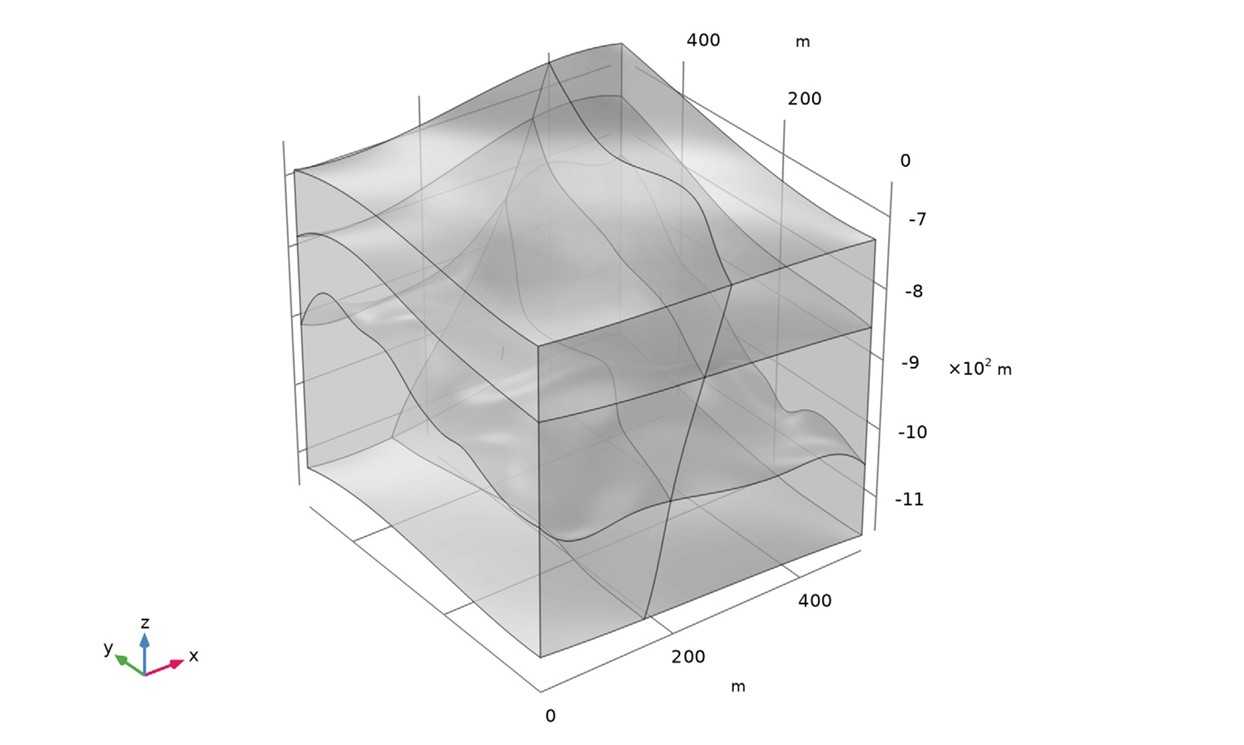
A geothermal doublet model built in COMSOL Multiphysics® illustrates the coupled subsurface flow and heat-transfer processes common to both system types. The example represents a hydrothermal reservoir with three geological layers intersected by a predefined fault zone (Figure 1). The geometry is constructed using an artificial dataset, with distinct hydraulic and thermal properties assigned to the geological layers.
The COMSOL Multiphysics® software provides all of the necessary physics couplings and boundary conditions for the model. In the coupling of interest, heat transfer and subsurface flow influence one another bidirectionally: Heat is transported by advection, and the fluid properties, such as density and viscosity, depend on the temperature.
By coupling subsurface flow and heat transfer, the model captures heat transport by moving groundwater and the influence of temperature-dependent fluid properties on flow. Once the initial values and boundary conditions are defined, the model runs a time-dependent simulation to measure production temperature over 15 years.
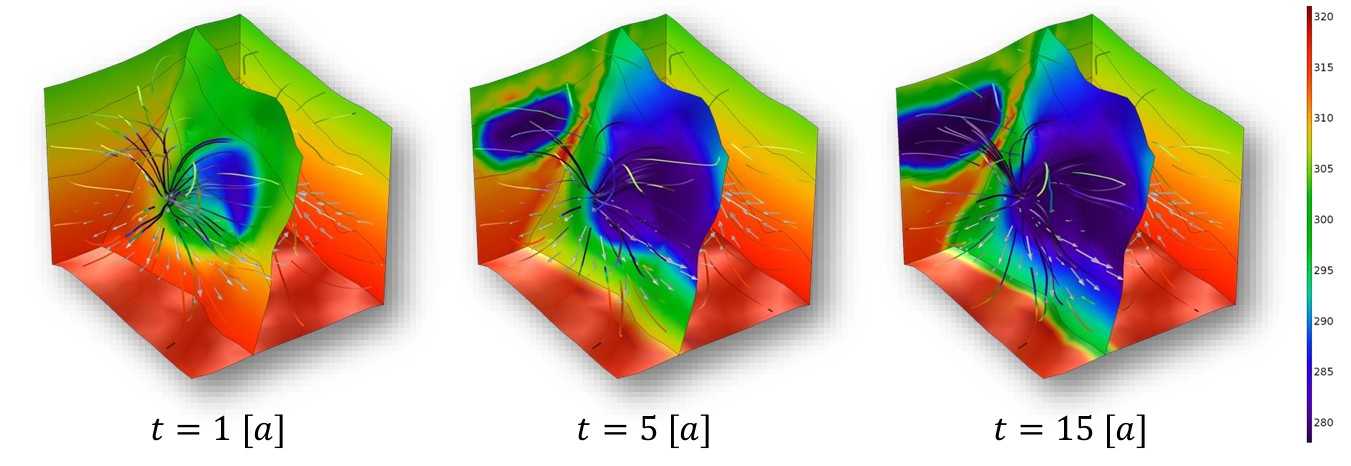
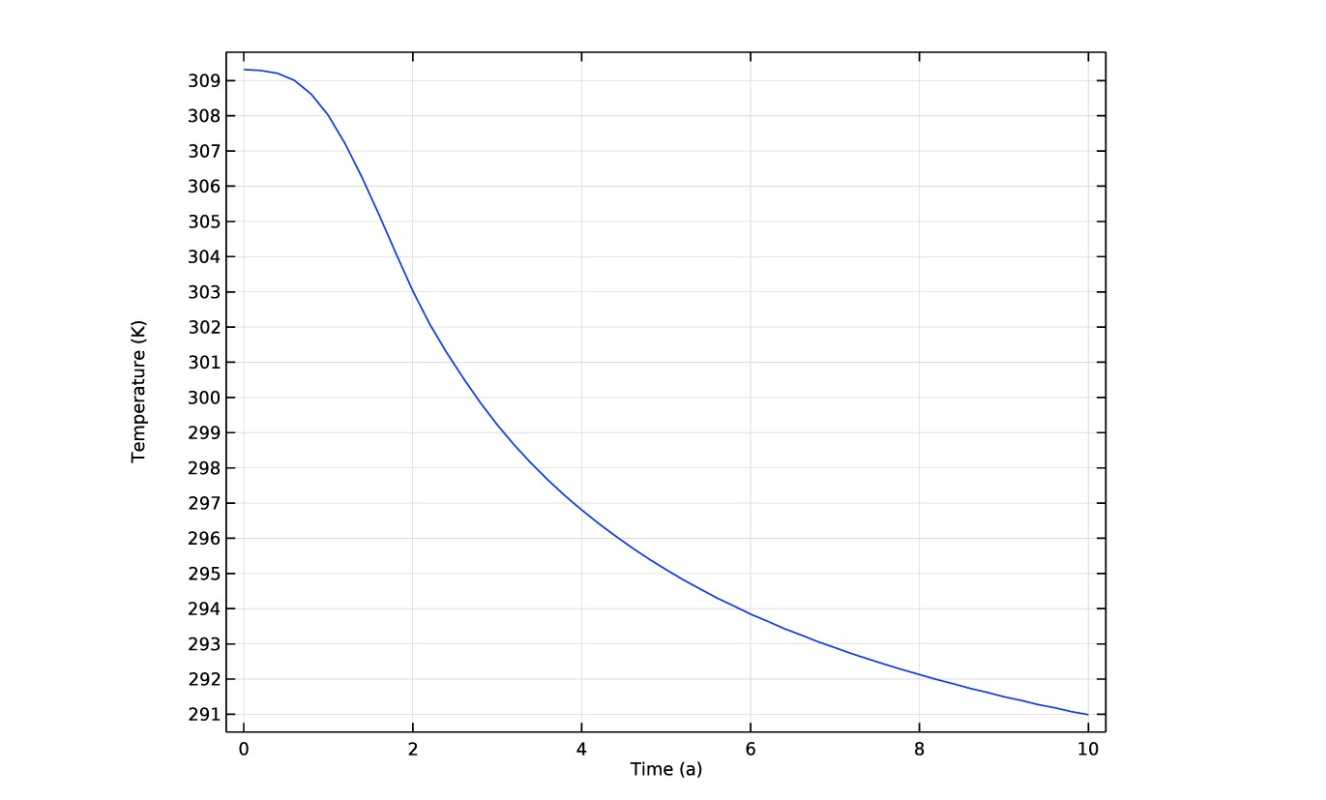
The simulation reveals that after 15 years of operation, the temperature in the fracture zone will drop significantly; over just 10 years, the production temperature will decrease by about 20 K (Figure 3), indicating that the doublet will not provide a stable, long-term energy supply under the current configuration.
The model parameters, from doublet orientation to the materials or fluids used, can be adjusted until the desired production outcome is achieved. The software’s long-term predictive capability has proven invaluable in research and planning, allowing users to adjust conditions and iterate efficiently.
COMSOL Multiphysics® can also be used in day-to-day EGS operations, with multiple practical applications thanks to the software’s compatibility with field data, robust yet flexible interfaces, and built-in functionality for creating streamlined, intuitive simulation apps that enable users without modeling expertise to run simulations based on underlying high-fidelity models.
A model of CO₂ storage in a geological formation demonstrates how real-world mapping data can be used to create high-fidelity geometries of subterranean reservoirs in COMSOL Multiphysics®.
The model was built using a dataset from the Johansen Reservoir, a saline aquifer off the coast of Norway. The model uses geological geometry, porosity, and permeability data from the Johansen Reservoir dataset, demonstrating how spatially varying geological properties can be incorporated into subsurface simulations.
The COMSOL® software provides flexible meshing tools and numerical solvers to efficiently handle complex reservoir geometries and spatially varying material properties.
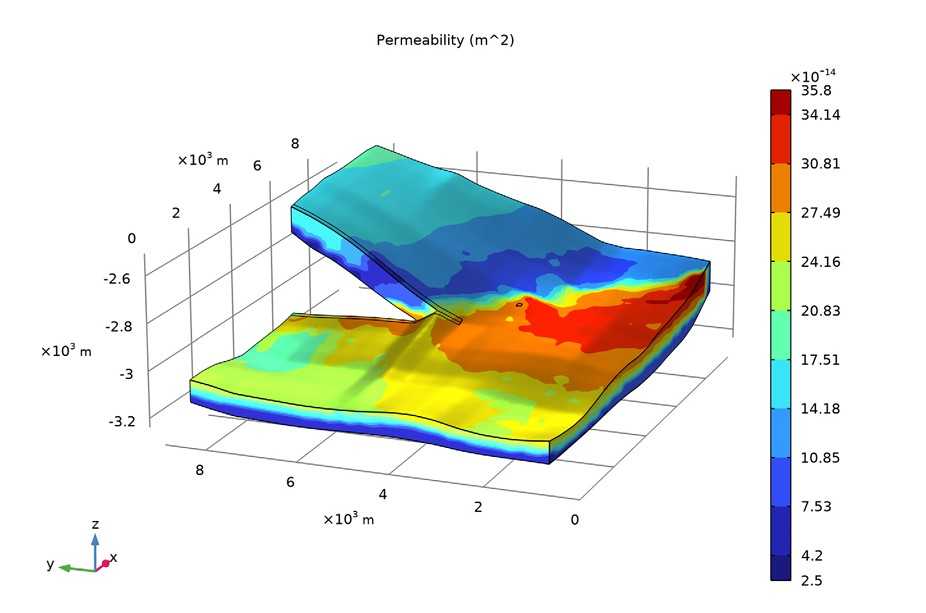
Subsurface conditions are often difficult to observe directly, making field measurements essential for refining reservoir models during operation.
COMSOL models can be integrated with external data systems to incorporate measurements such as temperature, pressure, and flow rate. These measurements can be used to update model parameters, improve estimates of reservoir conditions, and evaluate future operating scenarios.
When combined with automated data exchange and appropriate model validation, this approach can form the basis of a digital twin for geothermal reservoir monitoring and optimization.
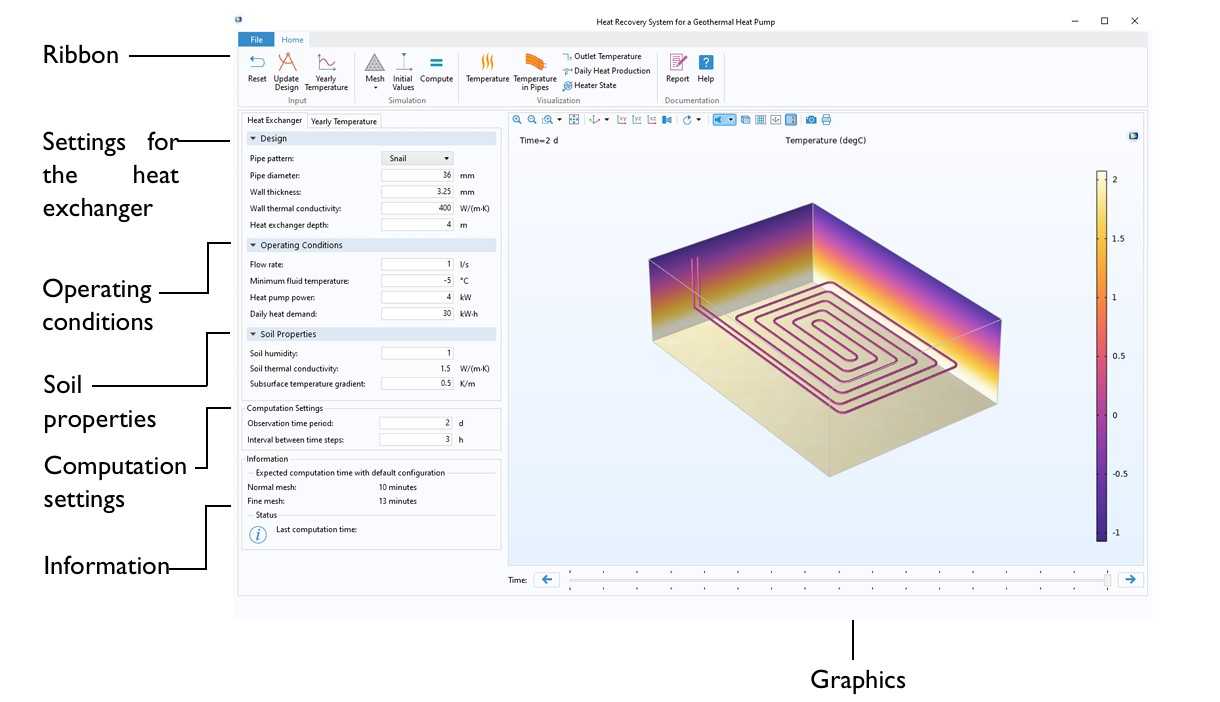
Once a model is created, you can deploy it across the organization using simulation apps. Apps package a full model’s computational power into simplified user interfaces, with input and output fields tailored to any team or industry.
For example, a multiphysics model of ground heat recovery for radiant floor heating measures heat transfer in a shallow geothermal heat recovery system where cold water enters through the pipe inlet and is returned as hot water through the pipe outlet.
A simulation app based on this model streamlines the interface for general users, letting them focus on input parameters and computational outputs without extraneous model information or requiring foreknowledge of the software.
COMSOL Multiphysics incorporates AI technologies that complement physics-based modeling and simulation. These capabilities range from AI-assisted modeling and programming to surrogate modeling used to accelerate computation of multiphysics models, simulation apps, and digital twins.
The built-in Chatbot window in COMSOL Multiphysics provides AI assistance directly within the COMSOL Desktop environment. By connecting to a large language model (LLM), users can ask modeling questions, get help with simulation workflows, and generate or troubleshoot COMSOL API code.
Users can also attach entire models or selected model components to their prompts, enabling the chatbot to provide context-aware assistance based on model settings, variables, expressions, and other information.
This integration makes AI assistance available directly within the modeling environment. The soon-to-be-released COMSOL Multiphysics version 2027 will extend AI support with MCP server functionality to enable agentic workflows.
Surrogate models provide fast, computationally efficient approximations of detailed physics-based models. COMSOL supports several techniques, including deep neural networks (DNNs) and Gaussian processes (GPs).
DNN and GP surrogate models can be trained on simulation results or experimental data to predict model responses for different input parameters. Once trained and validated, they can provide predictions in a fraction of the time required for a full simulation.
Applications include design optimization, parametric studies, inverse modeling, and interactive simulation apps.
AI functionality can also be used to enhance the performance of digital twins or dynamic models that interact with real-time field data.
When datasets about field conditions are incomplete, as is often the case in geothermal digs, DNNs can be used to interpolate gaps in the data. When trained on enough field data, these automatic interpolations can replicate conditions at the highest possible fidelity, creating digital twins with powerful monitoring capabilities.
Atop the bedrock of its high-fidelity multiphysics simulation software platform, COMSOL has added capabilities that can be used by geothermal engineers to accelerate innovation in both research and production.
Browse the COMSOL product suite to explore solutions for designing the future of geothermal energy extraction.
Member Focus articles are a paid member benefit and are provided by the featured Geothermal Rising member. They do not necessarily represent the views or positions of Geothermal Rising. Publication does not constitute an endorsement of the featured company, its products, services, or opinions.