
Keeping Tools Cool to Reach Hotter Geothermal Wells
Most BHA components in high-temperature wells are designed for a maximum operating temperature around 149°C (300°F). In contrast, formation temperatures in some shale and geothermal wells already exceed 177°C (350°F). As the circulation loop runs, the relatively cool mud that is pumped down the drillpipe absorbs heat from the hot rock around the wellbore. At the bit, the mud turns and returns toward the surface in the annulus as hotter circulating mud. Because the well is drilled overbalanced, native formation fluids stay in the rock, and it is the drilling mud that picks up and carries the heat. By the time mud reaches the bottom hole assembly, its temperature is much closer to the formation temperature, which is the temperature the tools actually have to withstand.
Elevated temperatures do more than stress electronics. They accelerate corrosion, erosion, and fatigue in steels and elastomers and degrade mud rheology, thinning the fluid and reducing its ability to clean the hole. The result is familiar to drilling engineers: more unplanned trips, more tool failures, and more non-productive time.
Whether the well is chasing gas in the Eagle Ford or heat in a geothermal project, the central question is the same. How do we keep the circulating system cool enough for the tools to survive, without sacrificing performance?
NOV’s Tuboscope business unit has spent decades developing internal coatings that extend tubular life by resisting corrosion, wear, and deposit buildup while maintaining hydraulic efficiency. As operators in oil and gas and geothermal began seeking a coating that could also serve as a thermal barrier, the research team focused on one key property: thermal conductivity.
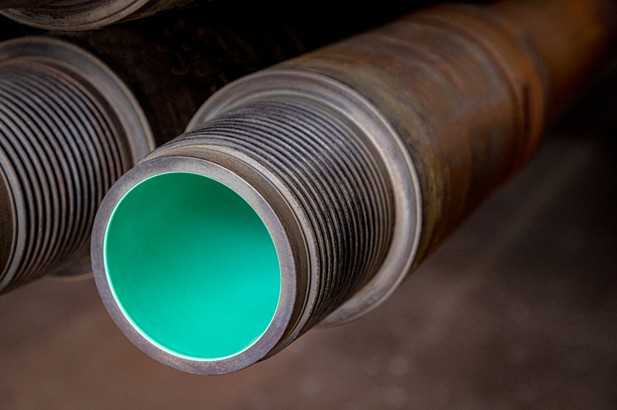
Carbon steel drillpipe has a thermal conductivity of roughly 45 W/m·K, so it readily conducts heat from hot rock and annular fluids into the cooler mud inside the pipe. Legacy internal coatings improved corrosion resistance but did relatively little to slow heat flow.
Using a heat flow meter, NOV tested candidate coatings across a wide temperature range.
Earlier coatings averaged about 0.84 W/m²K. Through multiple iterations, the team developed TK Drakōn with an average thermal conductivity of 0.162 watts per meter Kelvin, more than five times lower than that of previous coatings and nearly 280 times lower than that of steel. The inside of the pipe becomes a significantly cooler pathway for drilling fluid.
TK Drakōn was also subjected to high temperature, high-pressure exposure, immersion in corrosive solutions, and physical tests for abrasion, impact, and flexibility. The coating is applied in a thin 20 to 30 mil (0.5 to 0.75 millimeter) layer that preserves a smooth internal surface, supports efficient flow, and limits the buildup of scale and solids.
With more than 1.0 million feet (about 305,000 meters) of TK Drakōn-coated pipe in service, the coating has moved from concept to a standard option for high-temperature drilling. For geothermal developers, it offers a qualified way to manage heat along the drillstring while also protecting tubulars from aggressive brines.
Managing temperature inside the well starts at the surface. Once hot mud returns from the hole, it passes through shakers and solids-control equipment, then becomes a candidate for cooling before being pumped back downhole.
Conventional mud cooling often relies on evaporative or air-based systems that struggle in hot, humid environments and may require large volumes of water. Chillers use a closed refrigeration loop to remove heat from the fluid and can maintain precise temperature control without external water.
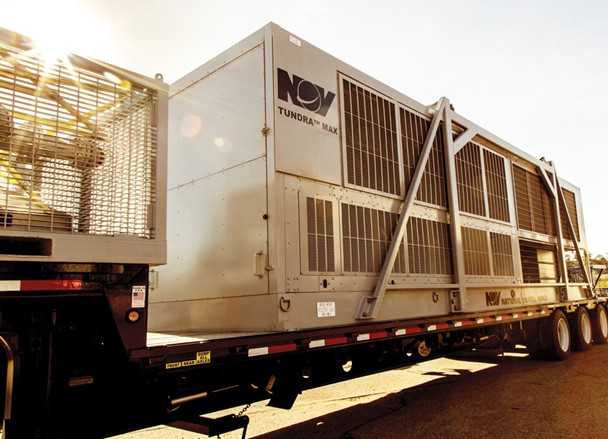
NOV’s Tundra Max mud chiller combines air cooling and chiller technologies in a two-stage, closed-loop package. In the first stage, an air cooling unit removes heat from the drilling fluid by transferring it into a circulating water loop. In the second stage, a refrigeration unit removes additional heat from the same water loop, allowing it to continue pulling heat from the mud. Both stages use plate and frame heat exchangers in a counter-flow configuration, where the drilling fluid flows in one direction, and the cooling water flows in the other, which increases contact and improves heat transfer from the hot drilling fluid to the cooling medium.
The trailer-mounted unit can handle oil-based, synthetic-based, and water-based muds. In the first stage, an air-cooling unit removes heat from the water loop. In the second stage, a refrigeration unit chills that loop further. Both stages use plate-and-frame heat exchangers in a counterflow configuration to transfer heat between the mud and the cooling medium.
At the rig site, Tundra Max draws relatively clean fluid from the suction tank, chills it, and returns it to the solids control tank, typically the hottest point in the surface system. The result is a continuous heat sink that pulls the overall system temperature downward before the mud is pumped back into the well.
In long, high-temperature laterals in South Texas, this integrated approach delivered measurable gains. In one case study, Tundra Max lowered the active mud temperature at the surface by an average of 29.5°C, from 61.7°C at the inlet to 32.2°C at the outlet. With the mud chiller alone, the bottom hole temperatures were reduced to about 186°C, even though the undisturbed formation temperature was close to 196°C. When the chiller was combined with TK Drakōn-coated drillpipe, the bottom-hole circulating temperatures in the wellbore dropped further to an average of 159°C. That additional margin improved the operating environment for downhole electronics and elastomers and reduced heat-related risks for personnel at the surface.
As lateral lengths approach 8 kilometers and geothermal concepts push toward supercritical and superhot conditions, drilling will increasingly be limited by the tools that can tolerate them, not just by rock mechanics. Temperature in the circulation system is something operators can actively design around.
For geothermal projects, whether conventional hydrothermal, enhanced geothermal systems, closed-loop designs, or superhot pilots, the path is similar. Assume active temperature management from the earliest phases of well design. Pair downhole insulation, such as TK Drakōn, with surface cooling, such as Tundra Max, as standard practice in high temperature campaigns. Use early wells in a field to tune bit selection, trajectory, hydraulics, and the thermal profile of the circulation system.
NOV is already extending its coating and cooling expertise into geothermal projects. These cross-sector lessons are relevant to a community experimenting with new well architectures and resource types while still relying on many of the same drilling fundamentals.
The story behind TK Drakōn and Tundra Max is less about individual products and more about a systems approach to heat. By reducing heat transfer into the drilling fluid and removing heat at the surface, NOV’s integrated system keeps BHAs operating closer to their rated lifespans, reduces non-productive time due to temperature-driven failures, stabilizes mud properties, and improves rig safety. Across multi-well campaigns, those gains compound and drive down cost per meter drilled.
As a participant in the Geothermal Rising community, NOV brings high-temperature drilling experience and a coatings and fluids portfolio that can be adapted for geothermal. In an industry-driven organisation that exists to connect subsurface innovators, this kind of technology transfer supports a shared goal: making clean, always on geothermal energy a practical choice in more places around the world.